Production guides
Corporate and Brand Interview Filming: Questions, People and Supporting Footage
A preparation guide for marketing and communications teams: define the audience, message, questions, contributors, location and deliverables. Includes an inquiry brief, even if you do not yet have a question list.
Decide who will watch and what they should understand
Founder, employee and customer interviews need different questions. Start by writing one sentence that identifies the audience and the purpose of the video. For business buyers, it may be useful to show how a product or service is selected and how work is actually carried out. For job applicants, consider a structure that explains working practices and individual roles. Try this first line in your brief: This video helps [audience] understand [something about our company or product] and take [a next step, such as an inquiry, consultation or application]. If there are several objectives, prioritise them and discuss whether separate edits are needed.
Plan the question or image that opens the first three seconds
The order of filming does not have to be the order of the finished video. Consider opening with a question your audience cares about, part of a key answer, or footage that makes the explanation clear. For example, an interview about quality checks could open with inspection footage and the question: What standards do you check against? A film about working practices could begin with a specific experience or the way a team makes a decision. These are illustrative approaches, not claims about an actual project or its results. Build the opening around material that can be shared and facts that can be checked. Decide how much company introduction or greeting the video actually needs.
Ask for specific experiences rather than praise
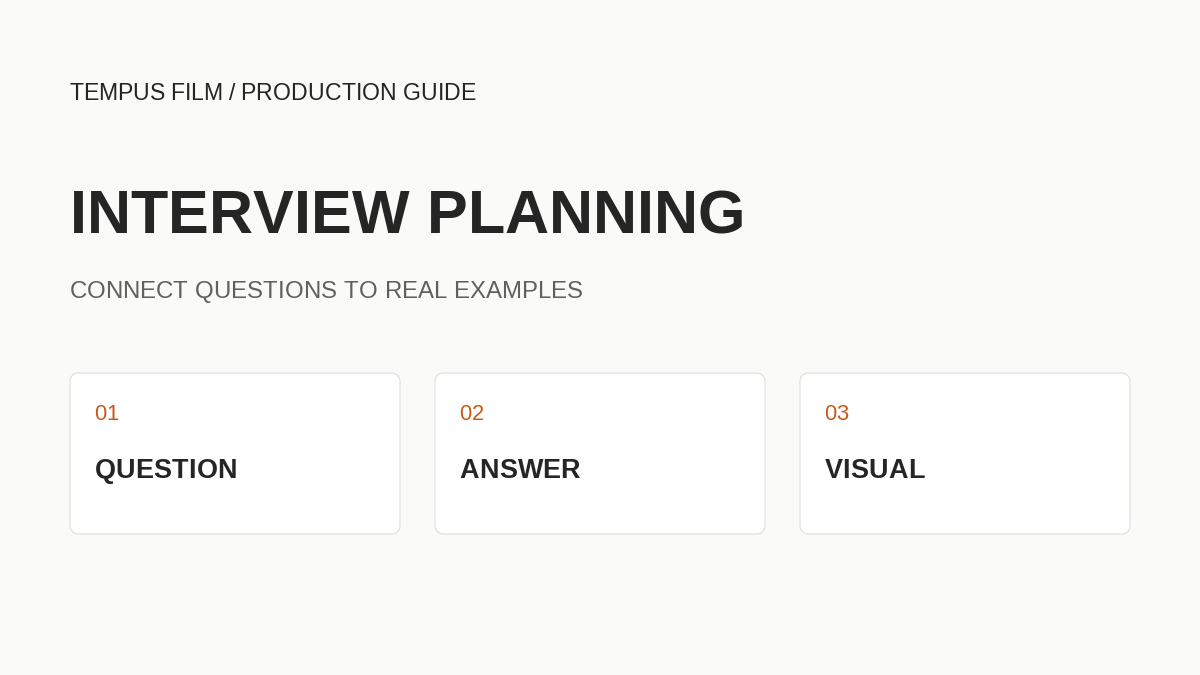
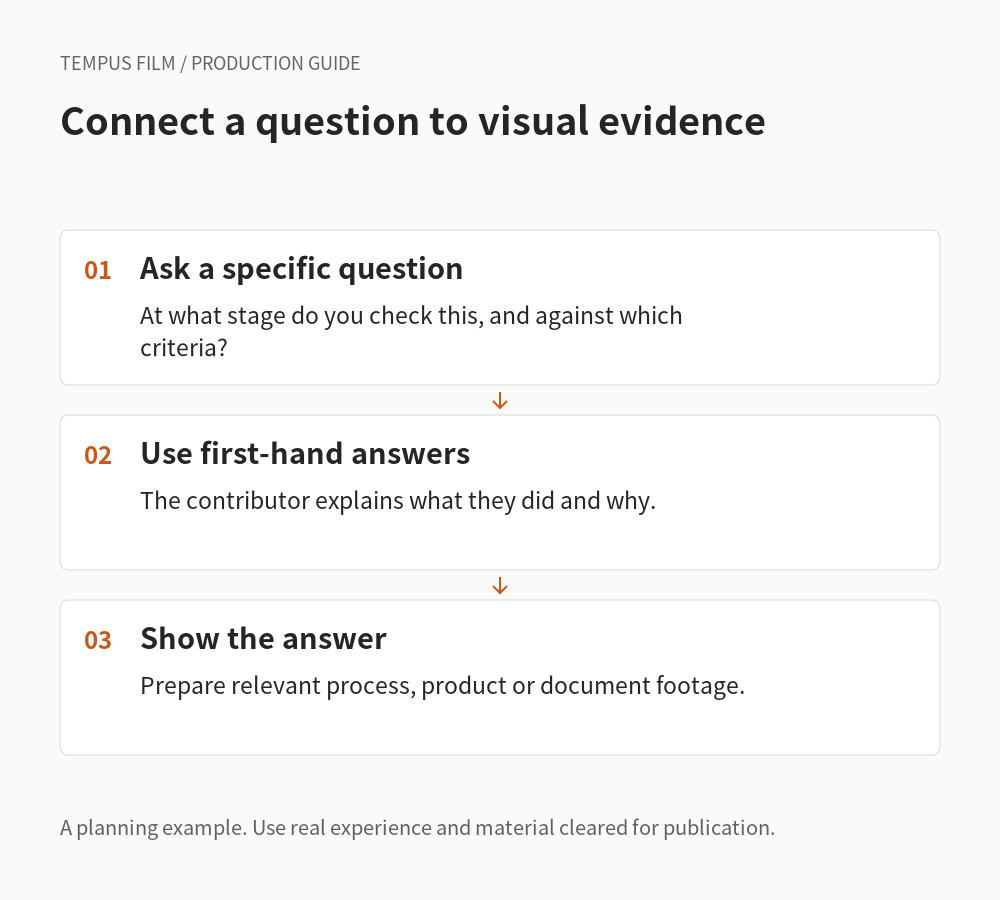
These examples turn broad questions into more specific prompts. Leave room for real experiences and evidence rather than prescribing the answer. What are your company's strengths? → What do you check first when a customer makes an inquiry? Why is the quality good? → At which stage do you check quality, against what criteria, and can we film that process? Were you satisfied with the product? → What was difficult before you used it, and what changed during use? What is the team atmosphere like? → How did you reach a decision the last time people disagreed? Follow up where needed: Can you give an example? What did you choose at that point? Is there material we can show? Base customer feedback and figures on actual statements and verifiable information.
Arrange the answers into a clear story
Rather than listing every question for each contributor, plan a sequence viewers can follow. One possible structure is situation → reason for the choice → actual process → verified change → next step. Situation: What problem or request came up? Reason: What guided your choice of approach? Process: Who did what? Verified change: What was different, and how can it be checked? Next step: What should the viewer explore or ask about? Not every interview needs a result or performance claim. If an outcome cannot be verified, focus on the process or decision criteria instead. When contributors repeat the same information, divide the questions around their individual roles and experiences.
Include supporting footage in the shot list
Planning images to accompany the answers makes the filming scope clearer. For longer explanations, consider relevant work, products, documents or concise on-screen text. Product or service: Actual use, key functions and the environment in which it is used. Company or process: Work stages, quality checks, hands and tools. Recruitment or team: Collaboration, workspaces and individual roles. Customer interview: Use footage and supporting materials that can be shared. Supporting footage may need time separate from the interview. Share when work actually takes place, which areas are accessible and which information must stay off camera. If a process is recreated for explanation, agree how to distinguish it from a record of the actual work.
You do not need a finished question list to get in touch
Tell us the video's purpose, the expected number of contributors and your preferred dates. If the questions or location are undecided, we can use what you have prepared to identify the next steps.
Discuss your interview shoot ↗Give contributors topics and examples to prepare
Share the purpose, intended audience, topics and likely questions before filming. Ask contributors to prepare experiences, work processes they can explain and any material that supports their answers. Whether to use a script or a few key points can be decided around the individual. Check names, job titles, affiliations, product names and the spelling and pronunciation of specialist terms. Identify information that cannot be shared or needs a separate review. Discuss clothing, visible logos, products and documents, and eye-line with the filming team. Allow separately for preparation and sound checks, the interview, supporting footage and any necessary retakes.
Check both the picture and the sound at the location
If you book a meeting room, check for nearby meetings, phone calls, announcements or construction during the shoot. Review heating, air-conditioning, machinery and outside noise in an on-site sound test. Confirm the background, space for equipment, power and access routes. If using a window-lit position, discuss how the light may change over the filming period. Name a contact for changes to the location or contributors. For filming inside a company or facility, share accessible areas, equipment access times and any sequence that could affect normal operations.
Agree the finished videos and review process
Deliverables: Confirm the number and target length of the main videos and whether you need vertical clips or language versions. Tell us whether the videos are for a website, sales presentations, recruitment or social media. Editing: Agree the answers, supporting footage, name captions, full speech captions, graphics and supplied materials to include. Review: Assign contacts for names, specialist terms and product information, and one person to consolidate feedback. Agree draft and final dates and the scope and number of revision rounds. Publication: Clarify contributor review, publishing channels and the permitted use of supplied material with the commissioning team. Request raw footage and project files separately if they are required.
Copy this filming brief into your inquiry
Company / brand / website: Audience / purpose of the video: Key message: Expected contributors / roles: Question list prepared?: Preferred shoot date / location: Products, work or spaces to film: Deliverables / publishing channels: Subtitle languages / additional edits: Preferred delivery date / budget range: Review contact / contact details: Mark undecided items as to be confirmed. If you have a reference video, explain which questioning approach or visual treatment you would like to explore rather than asking to reproduce the whole video.
Explore an interview-style brand collaboration
The published HMNS × Beyond Seoul collaboration offers a reference for the format and channel of an interview-style short. Its purpose and structure may differ from a corporate or recruitment interview, so tell us which elements interest you.
View the HMNS × Beyond Seoul collaboration ↗Start with the purpose and the people involved
Even without a completed question list, you can share what the video should communicate, who is likely to take part and your preferred dates. We will use that brief to discuss the questions, filming and editing scope.
Discuss your interview shoot ↗